Patience — The Patientia Virtue
Patience (Patientia) is emotional steadiness when timelines drag, plans jam, or people grate on your nerves. Far from passive resignation, the Patience measured by the 7 virtues test is active shock absorption: noticing rising heat inside yourself and refusing to spray it onto the nearest person.
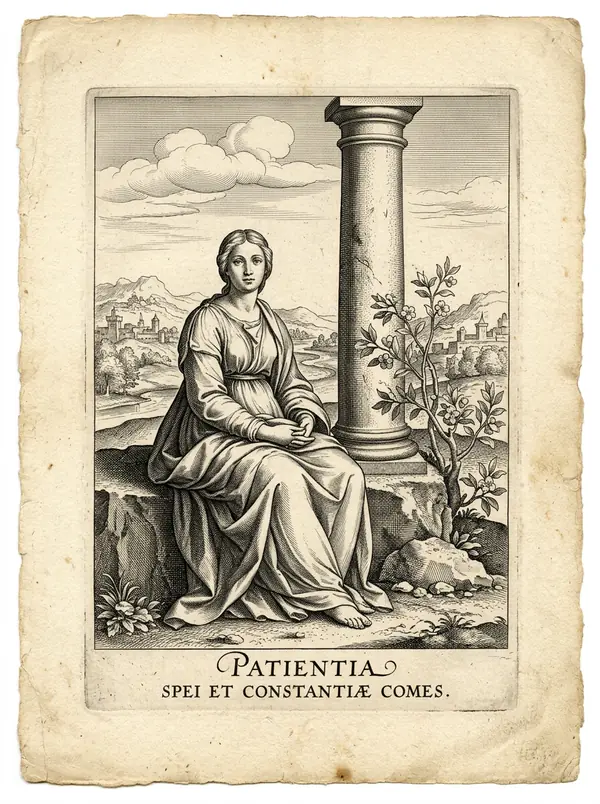
What Patience Measures in the 7 Virtues Test
Four statements evaluate your composure under friction: solving bottlenecks caused by others’ errors without raising your temperature, keeping sharpness out of your voice during slow service or repetitive questions, letting first irritation cool before answering unfair messages, and releasing frustration instead of replaying it for hours afterward.
Paired with Kindness, Patience produces The Peaceweaver—someone who lowers the room’s temperature precisely when everyone else is escalating. Paired with Diligence, it forms The Stone Carver, capable of staying steady through long timelines without rushing quality or snapping at bottlenecks.
How Patience Answers Wrath (Ira) Without Suppressing Standards
Patientia answers Ira—Wrath, or hot resentment triggered when reality refuses to obey our timetable. Modern wrath seldom arrives as dramatic yelling; more often it appears as clipped emails, passive-aggressive sighs, snappy tone toward service workers, and hours of silent internal rehearsal after an annoyance.
Patience lets you enforce high standards firmly without heat: you can fix a missed deadline directly while keeping respect intact. Instead of letting one minor inconvenience stain the rest of your afternoon, steady Patientia metabolizes delay cleanly and leaves your attention free for real work.
| Everyday Scene | Patience Response | Wrath Pull |
|---|---|---|
| An unfair or passive-aggressive message hits your inbox | Wait until your pulse steadies, then write a short, constructive reply focused on facts. | Firing off a pointed clapback within ninety seconds just to win the sting. |
| Traffic stalls or a clerk moves slowly while you are running late | Accept the delay immediately and stay courteous to the person right in front of you. | Sighing audibly or venting sharp frustration onto someone who did not cause the bottleneck. |
| Someone asks a question you already answered twice | Answer clearly once more and put the note in writing so it sticks. | Letting exasperation leak into every syllable. |
Three Concrete Habits to Strengthen Patience
Enforce a Mandatory 20-Minute Cooling Window on Hot Messages
Action cue: Draft your first emotional reply if needed, save it unsent, and revise after twenty minutes.
Time automatically filters sarcasm out while preserving clear boundaries.
Take Three Slow Exhales at Every Unexpected Delay
Action cue: Treat red lights, spinning loaders, and late arrivals as automatic cues for three unhurried breaths.
Physiological slowing lowers arousal before irritation writes your facial expression.
Separate Problem-Fixing From Tone-Punishing
Action cue: State plainly what went wrong and what changes next—zero sarcasm attached.
Proves that calm speech carries far more authority than snapping.
How Patience Scores Read Across the Four Tiers
Unformed
Delays, minor incompetence, and friction ignite sharp replies and hours of mental replay.
Situational
Calm when rested and unhurried, noticeably shorter-fused under schedule squeeze.
Steady
Dependable composure in tense rooms; occasional irritation cools quickly without collateral damage.
Dominant
Wide emotional buffer; you absorb shocks cleanly and keep people thinking straight under delay.
See Where Patience Ranks in Your Heptagon
Score Patience alongside the other six heavenly virtues with 50% reverse-scored items—and discover your Top-2 character archetype in under two minutes.